


The food court is the most intensively used space in any shopping centre. It’s where thousands of people sit, eat, linger, and decide whether they want to come back. Done well, a food court feels like a destination. Done poorly, it’s the space that lets the whole centre down.
At the centre of every great food court is great furniture. Not just chairs and tables — but a carefully considered mix of seating types, materials, configurations, and finishes that works operationally, holds up under enormous daily use, and reflects the design vision of the centre.
At Lain, we’re a specialist supplier of food court furniture to shopping centres, retail precincts, and dining destinations across Australia. We’ve partnered with developers, facilities managers, architects, and interior designers on food court fitouts ranging from neighbourhood centres to major Westfield-style developments. This guide covers everything you need to know — every furniture type, every key consideration, and how to build a food court furniture package that performs for years.


Why Food Court Furniture Is Unlike Any Other Commercial Furniture
Before getting into specific product types, it’s worth understanding what makes food court furniture a distinct category — and why choosing the wrong product is such a costly mistake.
A typical commercial office chair might see four to eight hours of use per day from a single user. A food court chair might turn over dozens of occupants across a twelve-hour trading day, seven days a week, 365 days a year. Add to that constant food and liquid spills, cleaning with commercial-grade chemicals, the physical stress of being dragged across hard floors, and the UV exposure of outdoor dining zones — and you have a product specification challenge that most furniture simply isn’t engineered to meet.
The best food court furniture is designed from the ground up for this environment. It’s built from materials that resist moisture, stains, and UV damage. It’s finished to withstand repeated cleaning without deteriorating. It’s designed for quick, safe stacking and reconfiguration. And it does all of this while still looking the part.
Getting this specification right from the start — rather than discovering the shortcomings after installation — is where Lain adds the most value for our clients.

1. Food Court Dining Chairs
Dining chairs are the backbone of any food court seating arrangement. They’re the most numerous furniture item in the space, and they’re the piece every single visitor interacts with directly — which makes them one of the most important specification decisions you’ll make.
What makes a great food court dining chair?
Durability above all. Food court dining chairs need to survive years of intensive use without wobbling, fading, or deteriorating. The structural integrity of the frame — whether steel, aluminium, or engineered polymer — is the starting point. Welds, joints, and hardware need to be commercial-grade throughout.
Cleanability. Upholstered chairs look premium but require careful specification for food court environments — fabric must be commercial-grade, stain-resistant, and capable of withstanding chemical cleaning. Many food court operators opt for hard-seat chairs (polypropylene, timber, or metal) that can be wiped down quickly between users.
Stackability. In food courts that require regular reconfiguration — for cleaning, events, or layout changes — stackable chairs are essential. Look for chairs designed to stack safely to at least six high, ideally more, with interlocking geometry that prevents slipping.
Comfort balanced with turnover. Unlike a restaurant, a food court typically benefits from furniture that’s comfortable enough to encourage a pleasant meal but not so plush that it encourages extended occupancy during peak periods. The chair’s ergonomics should suit a 20–40 minute dining experience.
Aesthetic range. Modern food courts move away from the plastic-on-metal aesthetic of a generation ago. Today’s food court dining chairs span timber, upholstered, wire, polypropylene, and mixed-material designs — often with custom colour and finish options to match the centre’s design language.
Lain’s seating range includes commercial dining chairs in a wide variety of materials and styles, all available in custom finishes. Whether your centre calls for a refined European aesthetic or a relaxed, casual feel, our team can help you find the right chair for the brief.

2. Food Court Bar Stools & High Stools
Bar stools and high stools serve a specific and important function in food court design — they create visual variety, maximise seating in compact zones, and cater to solo diners who prefer a higher vantage point.
Placed at high tables or counter-height benches along perimeter walls or feature islands, bar stools add a hospitality feel to food court environments that standard dining-height seating simply can’t achieve.
Specifying bar stools for a food court:
-Footrests are essential. Unlike a bar or restaurant where stools are used for shorter periods, food court stools may seat diners for twenty minutes or more. A well-positioned footrest significantly improves comfort at height.
-Seat height matters. Match stool height to your table specification — standard bar height is 750mm table / 650–700mm stool; counter height is typically 900–1050mm / 750–800mm stool.
-Swivel vs fixed. Swivel stools are more comfortable for extended sitting but require more maintenance over time. Fixed stools are simpler and more durable for high-volume environments.
-Stackability. If your high stool zones require regular reconfiguration, specify a stackable model. Not all bar stools stack — confirm this early in the specification process.
-Base construction. Four-leg bases are the most stable and durable for food court use. Pedestal or central column bases look elegant but require more careful specification for structural integrity at scale.

3. Food Court Tables
Food court tables take more daily punishment than almost any other commercial furniture product. They’re the landing zone for hot food, heavy trays, spilled drinks, and the mechanical stress of thousands of daily placements and movements. Specifying the right table — top, base, and configuration — is just as important as getting the seating right.
Table tops for food courts
The most practical food court table tops combine durability, easy cleaning, and a finish that holds up aesthetically over years of use.
HPL (High Pressure Laminate) is the workhorse of food court table tops — durable, stain-resistant, available in an enormous range of colours and textures, and straightforward to replace if damaged. It’s the most commonly specified surface in high-volume food courts.
Compact laminate is thicker and more robust than standard HPL, with the finish carried through the full thickness of the board. It performs exceptionally well in wet or outdoor environments and is worth the premium for high-traffic zones.
Timber surfaces bring warmth and a premium feel to food court environments but require careful specification and finishing to withstand intensive use. Polyurethane top coats provide the best protection. Solid timber and stone or engineered stone tops are typically reserved for feature communal tables or premium dining precincts where aesthetics are prioritised and the furniture specification reflects an elevated brief.
Table bases for food courts
Pedestal (central column) bases are the most popular choice for food court dining tables. They maximise leg clearance beneath the table, allow chairs to be tucked in fully, and create a cleaner visual from across the space.
Four-leg bases are more structurally robust and appropriate for heavier table tops or heavily loaded surfaces (such as communal tables that seat large groups).
Fixed/floor-mounted tables are an excellent choice for permanent seating zones. Floor mounting eliminates wobbling entirely, prevents the table from being moved or damaged, and significantly reduces maintenance over the life of the furniture.
Table sizing and configuration
Standard dining height: 750mm
Bar/counter height: 900–1050mm
Individual dining (2-seater): 600–700mm square or round
4-seater dining: 800–900mm square, or 900mm round
Communal tables: 800–1000mm wide, lengths from 1800mm to 4000mm+
For food courts, a mix of table sizes and configurations — rather than a single uniform size throughout — creates a more dynamic and functional space that accommodates solo diners, couples, families, and groups comfortably.
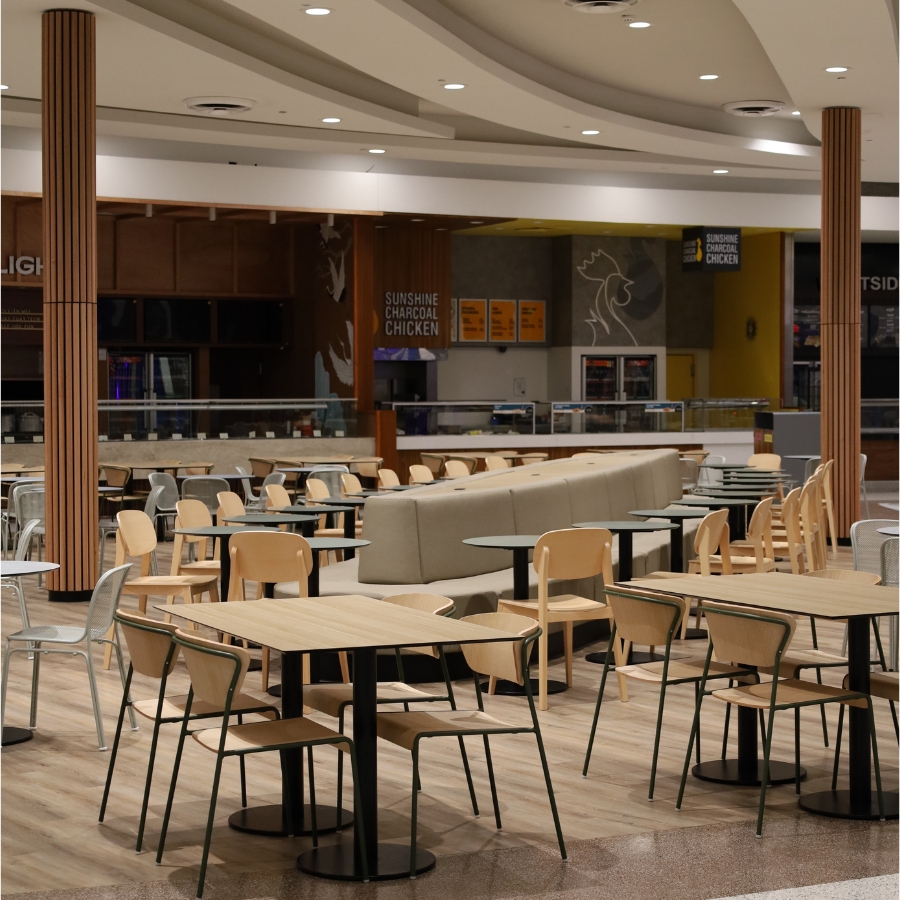
4. Banquette Seating for Shopping Centres
Banquette seating has become one of the defining features of modern food court design in Australia. Walk into any recently refurbished Westfield, Vicinity, or Scentre Group centre and you’ll find banquettes — fixed seating structures that line perimeter walls, frame seating zones, and create the spatial anchor points that define how the food court feels and flows.
Done well, banquette seating:
-Maximises seating capacity in perimeter and wall zones
-Creates a sense of enclosure and intimacy within a large open space
-Adds significant design impact through material, form, and colour choices
-Integrates with joinery elements like integrated planters, feature frames, and waste bin units
-Reduces furniture management requirements, as banquettes are fixed and don’t need to be repositioned
Banquette specification considerations:
Frame construction. Commercial banquettes are typically built on a structural timber or steel frame. The frame needs to be engineered for the specific dimensions and seating loads of the installation — this is not a product to cut corners on.
Upholstery. Food court banquette upholstery must be commercial-grade — typically a heavy-duty vinyl or commercial fabric with a Martindale abrasion rating appropriate for food court use (10,000+ rubs minimum; 30,000+ for high-traffic zones). The material must also be cleanable with commercial chemicals without deteriorating.
Back height. Low-back banquettes (to seat shoulder height) create an open, airy feel. High-back banquettes (above head height) create privacy and enclosure — popular in premium food hall and dining precinct environments.
Integration. The most impactful banquette installations integrate with the broader fitout — with planters built into dividing walls, waste stations incorporated into the banquette ends, and lighting integrated into the overhead structure.
Lain works with shopping centre developers, architects, and interior designers to deliver custom banquette systems — from design and engineering through to manufacture and installation.

5. Communal Tables
The large communal table is one of the most significant shifts in food court design over the past decade. Where food courts once consisted entirely of individual 4-seater tables, today’s leading centres anchor their seating plans around long communal tables that seat eight, twelve, or more people across a single surface.
Communal tables serve several functions simultaneously:
-They create a social atmosphere that makes solo dining feel comfortable
-They maximise seating density in central zones
-They provide the visual centrepiece of the food court — a feature moment that anchors the space
-They accommodate groups of varying sizes without requiring multiple tables to be pushed together
Communal table specification:
-Length: typically 2400mm to 4800mm, in single or joined configurations
-Width: 800–1000mm for dining; up to 1200mm for feature communal tables
-Height: standard dining (750mm) or bar height (900mm+), depending on the seating type
-Surface: typically a premium material — solid timber, engineered stone, feature HPL, or a combination
-Base: heavy-duty steel frame, pedestal legs, or floor-mounted trestle bases
Communal tables are often where the most significant design investment is made in a food court fitout. They’re the hero piece — and they should look and perform accordingly.
6. Food Court Lounge Seating
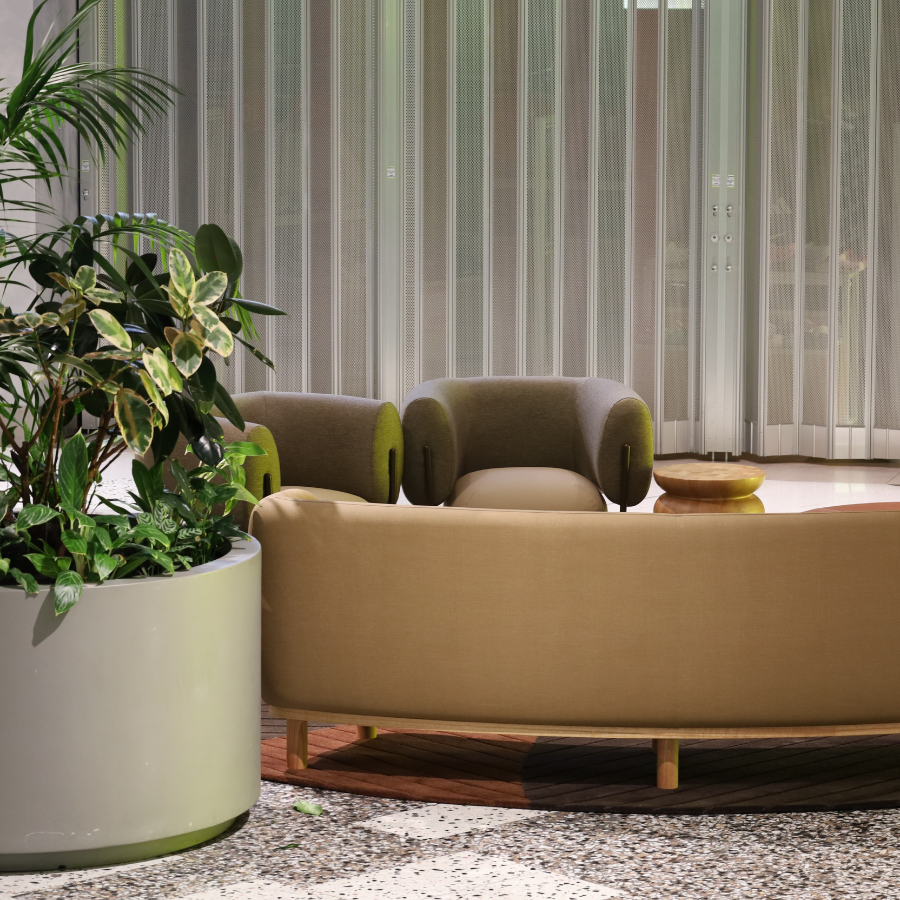
Not every food court visitor wants to sit at a dining table. The trend toward food courts as destinations — spaces to spend time, not just eat and leave — has driven strong demand for lounge seating within food court environments.
Soft lounge chairs, ottomans, and low-profile seating zones create rest areas that serve shoppers waiting for food, parents supervising children, or visitors taking a break from a long shopping trip. In premium food court environments and mall common areas adjacent to dining precincts, lounge seating blurs the line between retail rest space and dining environment.
For lounge seating in food court-adjacent zones, specify:
-Commercial-grade upholstery rated for high foot traffic and easy cleaning
-Foam density appropriate for sustained use (minimum 35kg/m³ for commercial applications)
-Structural frames built for commercial load ratings
-Easy chair or armchair profiles that allow comfortable sitting without promoting extended occupancy in peak trading periods

7. Outdoor Food Court Furniture
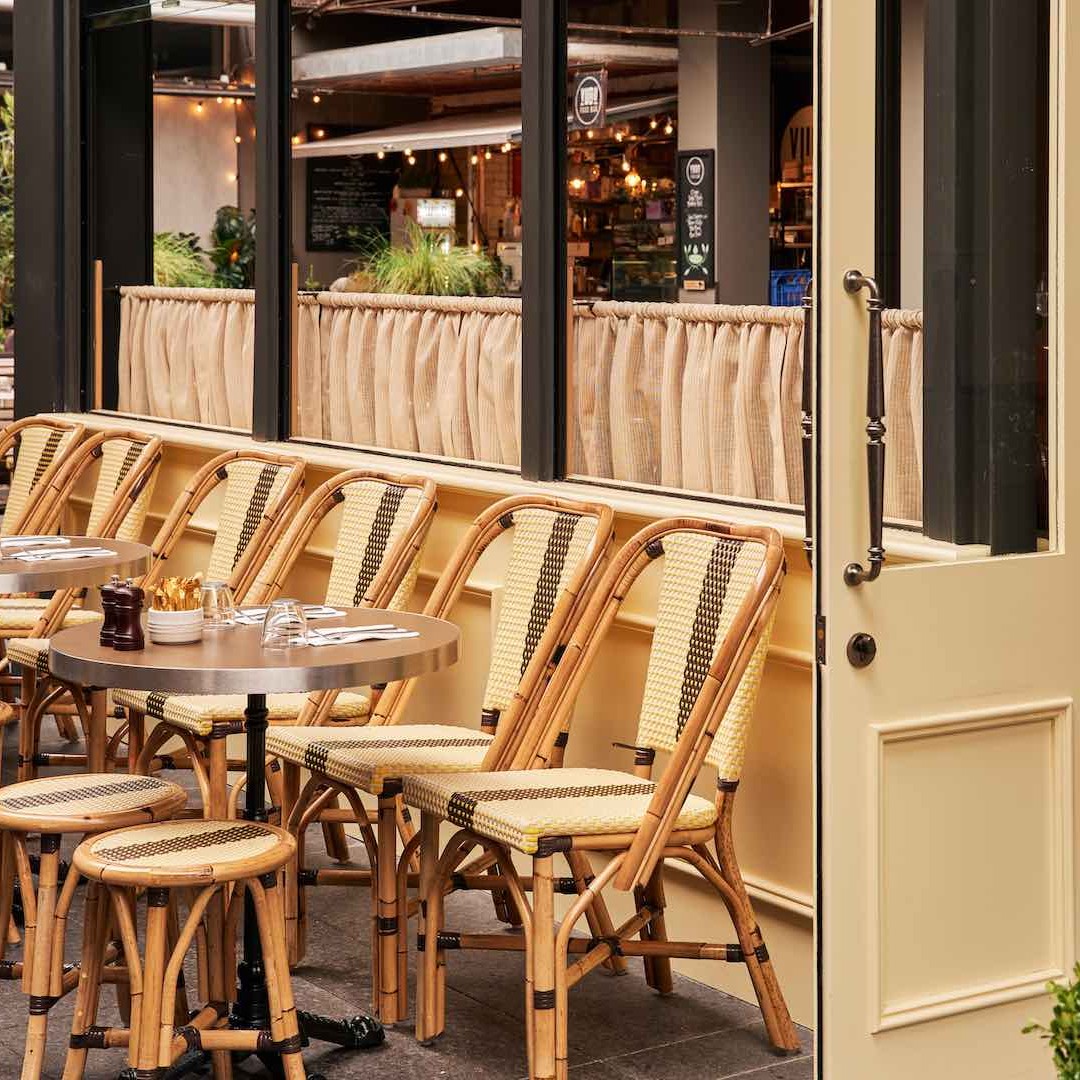
Alfresco dining zones are an increasingly important part of the Australian food court offer. Whether it’s a rooftop dining precinct, an external plaza, or a sheltered outdoor dining terrace, outdoor food court furniture requires a distinct specification approach.
Key requirements for outdoor food court furniture:
UV stability. Direct sun exposure in the Australian climate is brutal on furniture. Powder-coated finishes, UV-stabilised polypropylene, and marine-grade stainless steel are the most appropriate choices. Avoid timber that hasn’t been specifically treated and certified for outdoor commercial use.
Weather resistance. All materials and finishes must be rated for exposure to rain, humidity, and temperature variation. Sealed frames, stainless steel hardware, and weatherproof surface finishes are essential.
Weight and anchorage. Outdoor furniture in exposed locations may need to be weighted or anchored to prevent movement in high winds — particularly important for lightweight chairs and tables in elevated dining terraces.
Drainage. Tables and chairs that pool water are uncomfortable and unhygienic. Specify surfaces with appropriate drainage profiles for outdoor use.
Aesthetic continuity. Ideally, outdoor furniture reads as a cohesive extension of the indoor food court rather than a separate specification. Many of Lain’s indoor ranges have outdoor-rated variants designed to achieve exactly this consistency.
8. The Full Food Court Furniture Package
The most efficient way to approach a food court fitout — whether it’s a new development or a refurbishment — is to specify a complete furniture package rather than individual categories in isolation.
A full food court furniture package typically includes:
Dining chairs — the primary seating, specified in appropriate quantities and configurations for the food court’s seating capacity
Bar stools and high stools — for counter-height seating zones, perimeter benches, and feature islands
Dining tables — in a mix of 2-seat, 4-seat, and 6-seat configurations
Communal tables — as feature centrepiece elements in the seating plan
Banquette seating — fixed seating for perimeter and zone-defining walls
Lounge seating — for soft seating zones adjacent to the dining area
Outdoor furniture — weather-rated versions of the indoor specification for external zones
Waste bins and recycling stations — integrated into the furniture plan from the outset
Planters — as dividers, zone markers, and design elements within the seating layout
Specifying these categories as a coordinated package — rather than procuring each from different suppliers — delivers a cohesive design outcome, simplifies project management, and typically reduces total cost.
What to Ask When Specifying Food Court Furniture
Whether you’re a facilities manager, property developer, interior designer, or project manager, the following questions will help you evaluate food court furniture options effectively:
1. What is the furniture’s commercial rating?
Not all “commercial furniture” is created equal. Ask for the specific load rating, abrasion rating (for upholstered pieces), and any relevant testing certifications.
2. How is it cleaned, and what chemicals are safe to use?
Food court furniture will be cleaned with commercial products. Ask specifically what the manufacturer recommends and what will damage the finish or structure.
3. What is the lead time and how is it managed?
Food court refurbishments typically operate to non-negotiable opening dates. Ask about lead times, stocking arrangements, and what happens if delivery is delayed.
4. What is the warranty and what does it cover?
A genuine commercial furniture warranty should cover structural defects for a minimum of 3–5 years. Be specific about what’s included.
5. Can it be customised to our finish and colour palette?
For most food court applications, standard catalogue colours won’t match your design intent. Confirm the range of custom finish options and any minimum order requirements.
6. Who else have you supplied?
Ask for references from comparable shopping centre projects. A supplier with a track record in food court fitouts will be able to demonstrate real-world performance in comparable environments.
Why Shopping Centres Choose Lain for Food Court Furniture
Lain is a specialist supplier of food court furniture and shopping centre furniture across Australia. Our range is selected specifically for high-traffic retail and dining environments — designed in Europe, available in custom finishes, and backed by our team’s expertise in commercial furniture specification.
We work with shopping centre developers, property managers, architects, and interior designers across the country — from initial concept and specification through to delivery, installation, and ongoing support.
Our food court furniture range includes:
Commercial dining chairs — in a wide range of materials, profiles, and custom finishes
Bar stools and high stools — for counter and bar-height seating zones
Dining tables — individual and communal, in standard and custom sizes
Banquette seating — custom designed and manufactured to brief
Lounge and easy chairs — for soft seating zones adjacent to the food court
Outdoor-rated furniture — for alfresco and external dining zones
Mall common area furniture — seating, tables, and accessories for the broader centre
We also supply commercial bins, recycling stations, and planters — meaning you can source your complete food court furniture package from a single specialist supplier.
Start Your Food Court Furniture Project with Lain
If you’re planning a food court fitout, refurbishment, or furniture refresh, our team is ready to help. We offer an obligation-free consultation and can develop a tailored furniture package to suit your brief, budget, and project timeline.
Explore our food court seating range →
Browse our commercial tables →
View completed shopping centre projects →
Contact our team to discuss your food court project →
